SplatSLAM
Dense 3D Reconstruction from Monocular Video via Learning-based SLAM and Gaussian Splatting.
Dense 3D Reconstruction from Monocular Video via Learning-based SLAM and Gaussian Splatting
Southern University of Science and Technology
Demo
We place the demos first so the reconstruction results can be viewed immediately. These embedded videos and interactive viewers are migrated from the original Google Site.
Video Previews
Interactive Point-cloud / Reconstruction Viewers
Abstract
We present SplatSLAM, an end-to-end indoor scene reconstruction pipeline that bridges the gap between learning-based dense SLAM and photo-realistic novel view synthesis. Our method leverages MASt3R-SLAM to recover accurate camera trajectories and dense geometric point clouds from monocular RGB video captured by consumer smartphones.
To address the inherent noise and outliers in raw SLAM outputs, we introduce a standardized point cloud post-processing workflow, including Statistical Outlier Removal (SOR) and voxel downsampling, as a crucial transition module. By integrating these optimized priors, we initialize and train 3D Gaussian Splatting (3DGS), enabling real-time, high-fidelity rendering of complex indoor environments.
Evaluations on the 7-Scenes benchmark and self-collected SUSTech campus datasets demonstrate that our pipeline significantly improves localization accuracy compared to traditional feature-based SLAM, while delivering superior visual reconstruction quality.
- End-to-End Workflow: bridging monocular mobile video input to interactive 3D digital twins.
- High Precision: achieving sub-10cm trajectory accuracy on public benchmarks without camera calibration.
- Noise Robustness: integrating SOR denoising to eliminate floaters and SLAM artifacts.
- Photo-realistic Rendering: achieving PSNR up to 49.46 dB for complex indoor novel view synthesis.
Methodology
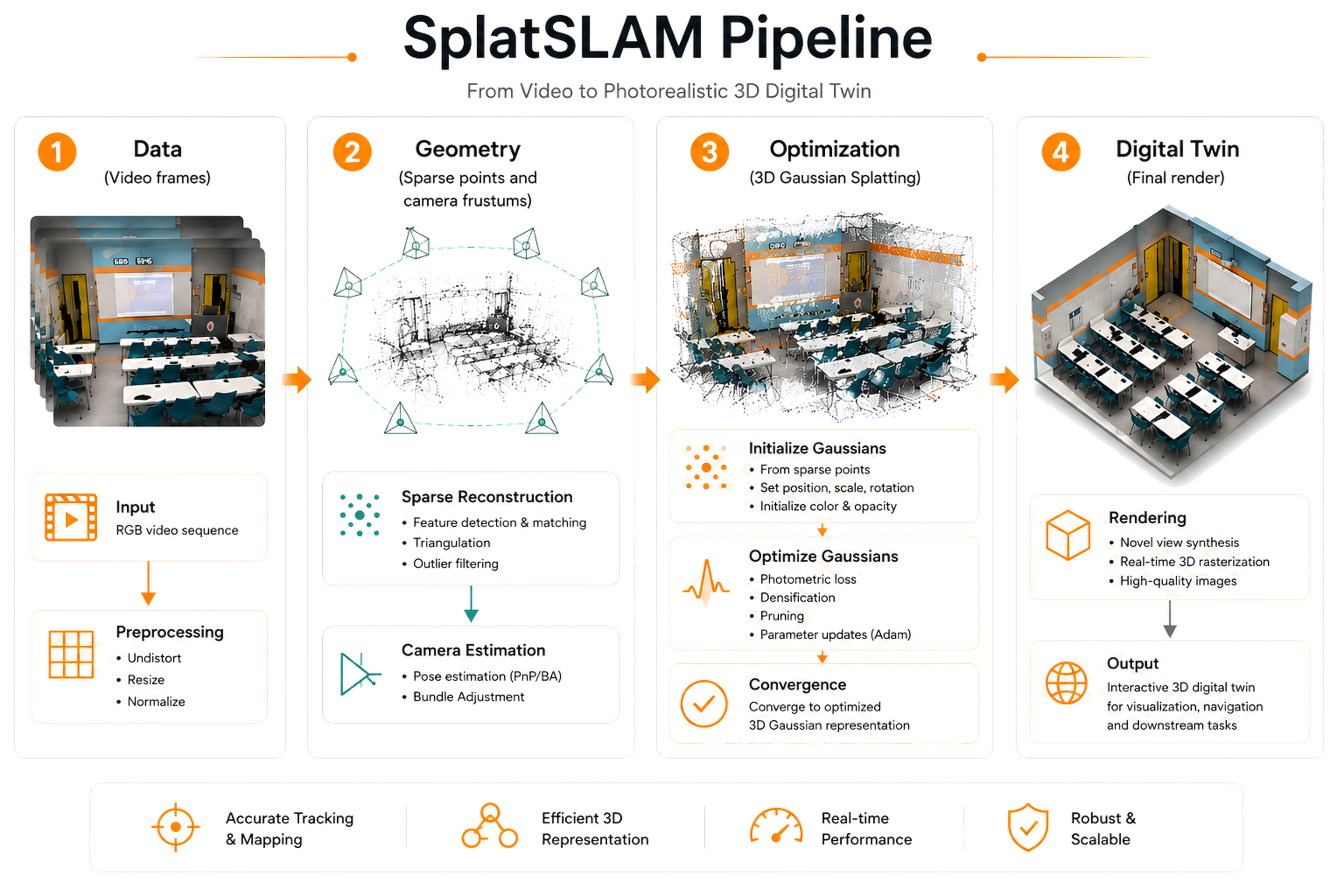
Our pipeline integrates advanced transformer-based SLAM with explicit radiance field rendering to achieve high-fidelity reconstruction. The workflow is divided into four core modules.
1. Data Preprocessing & Standardization
We capture 4K monocular videos using smartphones and extract frames at a fixed rate of 10 FPS using FFmpeg. This standardizes image resolution and naming conventions across public benchmarks and self-collected SUSTech datasets.
2. Dense Tracking and Mapping with MASt3R-SLAM
The system employs MASt3R-SLAM as the front-end. Pixel-level transformer matching and global bundle adjustment estimate camera trajectories and generate dense colored point clouds without requiring depth sensors.
3. Standardized Point Cloud Refinement
We use CloudCompare for SOR denoising, voxel downsampling, and manual masking, removing floating artifacts and improving training efficiency for 3DGS.
4. 3D Gaussian Splatting & NVS
The refined point cloud initializes Gaussian ellipsoids. The splatfacto framework optimizes position, covariance, and color through photometric loss minimization for real-time novel view synthesis.
Experiments
Experimental Setup
Datasets: 7-Scenes public indoor SLAM benchmark and self-collected SUSTech campus scenes including classrooms and kitchens.
Hardware: NVIDIA RTX 4090 with 24GB VRAM.
Software: PyTorch, Nerfstudio, and CloudCompare.
Phase I: Quantitative SLAM Benchmarking
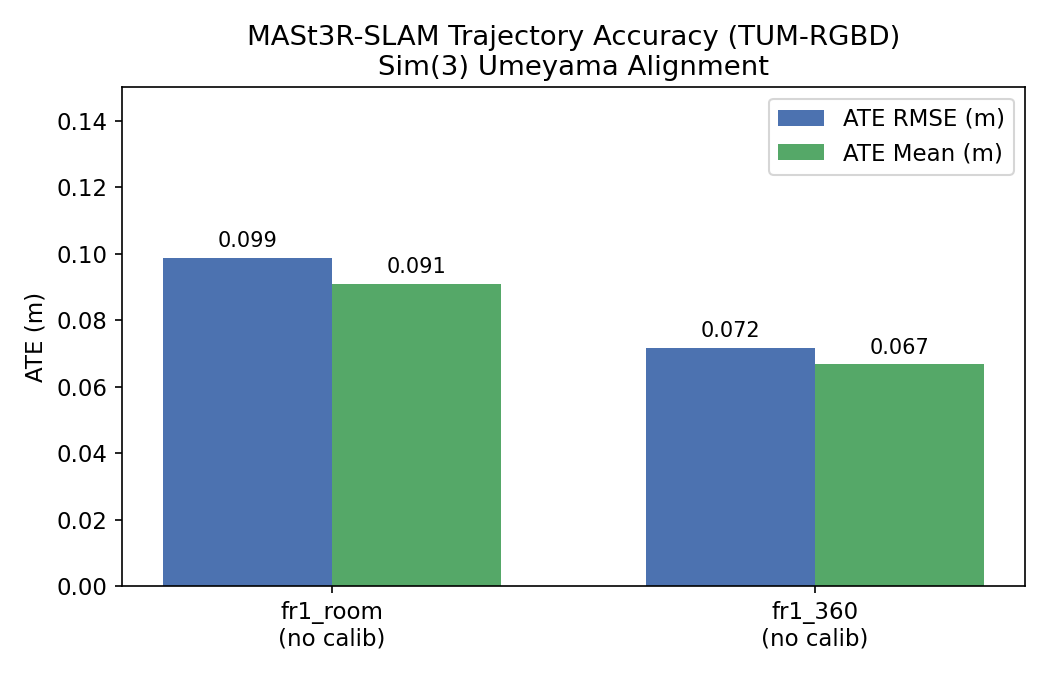
We evaluate MASt3R-SLAM on the TUM-RGBD benchmark. The system achieves higher precision in 360° rotation scenes due to dense feature matching, compared with the larger-scale room sequence.
| Sequence | ATE RMSE ↓ | Notes |
|---|---|---|
| Room sequence | 0.098 m | Larger-scale indoor trajectory with sub-10cm localization accuracy. |
| 360° rotation scene | 0.071 m | Higher precision under rotational motion due to dense feature matching. |
ATE measures the absolute distance between estimated and ground-truth camera poses. RMSE represents the overall average error across frames. Since monocular SLAM cannot recover absolute scale, we perform Sim(3) Umeyama alignment before calculating the error for fair comparison.
Phase II: Geometric Robustness & Scene Saliency
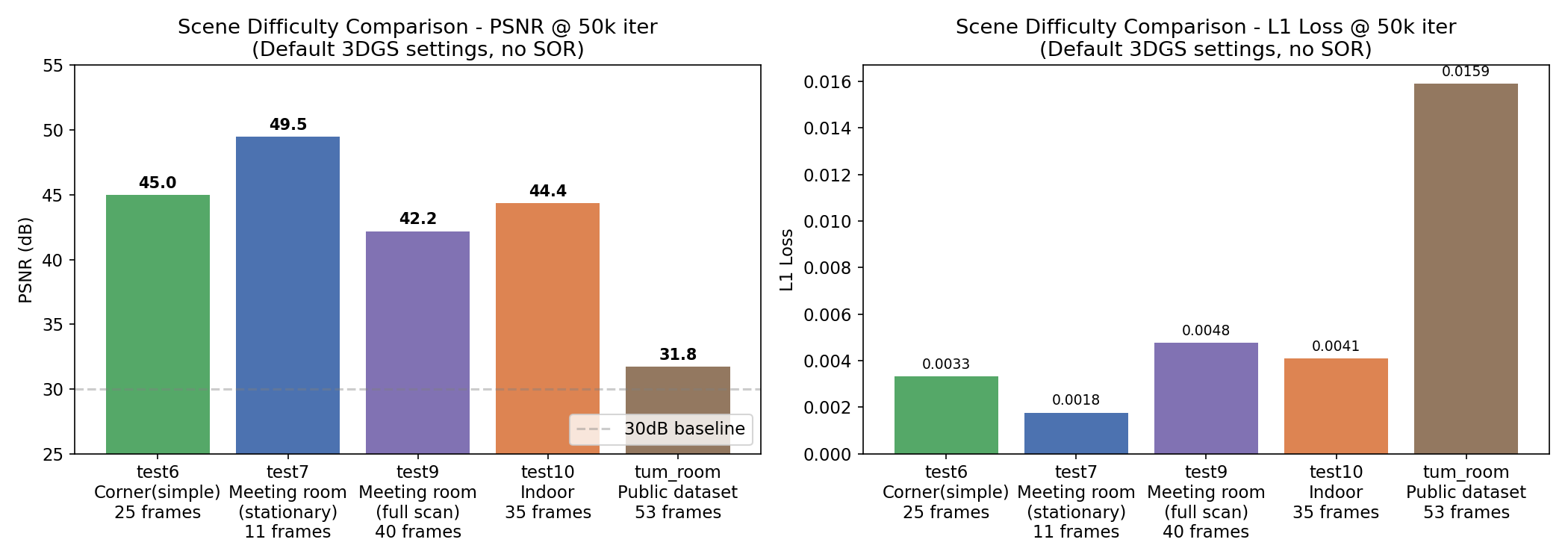
By comparing self-collected scenes, we observe that reconstruction quality is highly dependent on visual saliency. The pantry yields denser point clouds due to rich textures, while blank corners and texture-less walls result in sparse geometry and floating artifacts.
Evaluated scenes include meeting room 360, meeting room, tea room, and corner scenes.
Phase III: Rendering Fidelity & Convergence
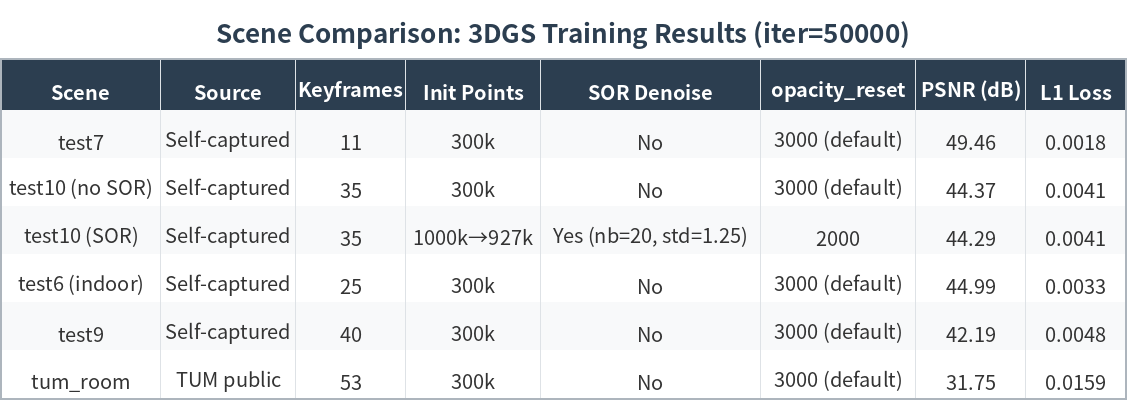
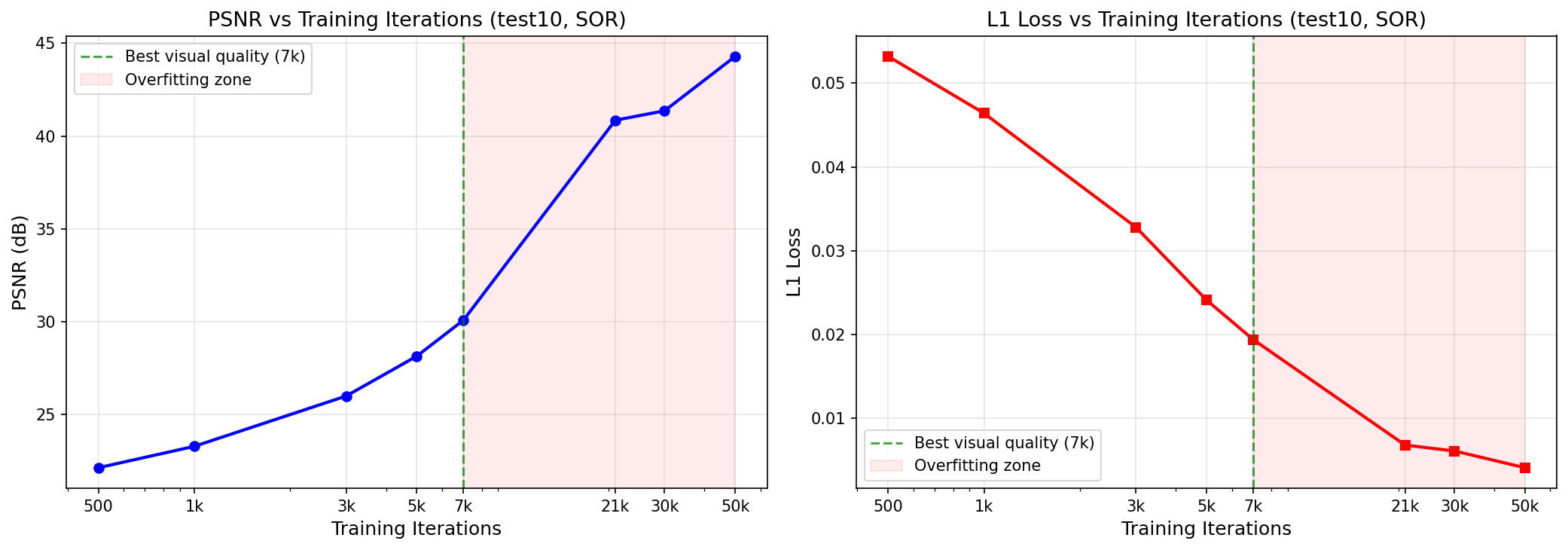
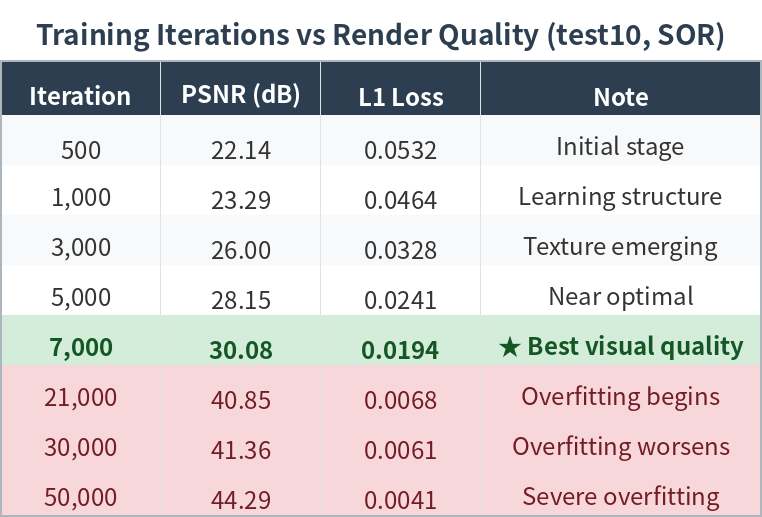
We analyze the 3DGS training evolution from 7k to 50k iterations. The visual quality reaches a practical sweet spot around 7,000 iterations for small-scale indoor scenes, while 50k iterations can achieve higher PSNR and more photorealistic specular details.
Texture Sensitivity: From Pantry to Blank Wall
We evaluate environments with varying texture densities. Richly textured pantry scenes yield more complete geometry, while blank walls are a failure case for monocular SLAM because the lack of salient features leads to sparse points and floating artifacts.


Ablation Study: Impact of SOR Denoising
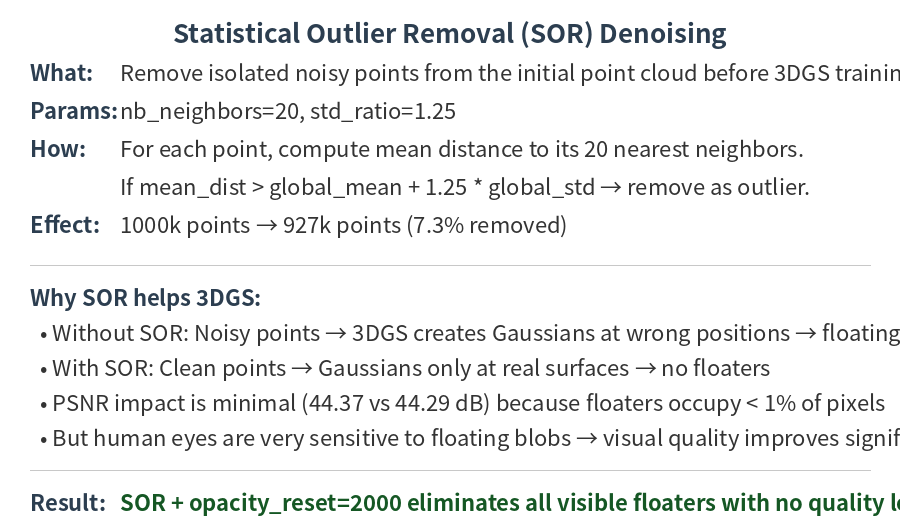
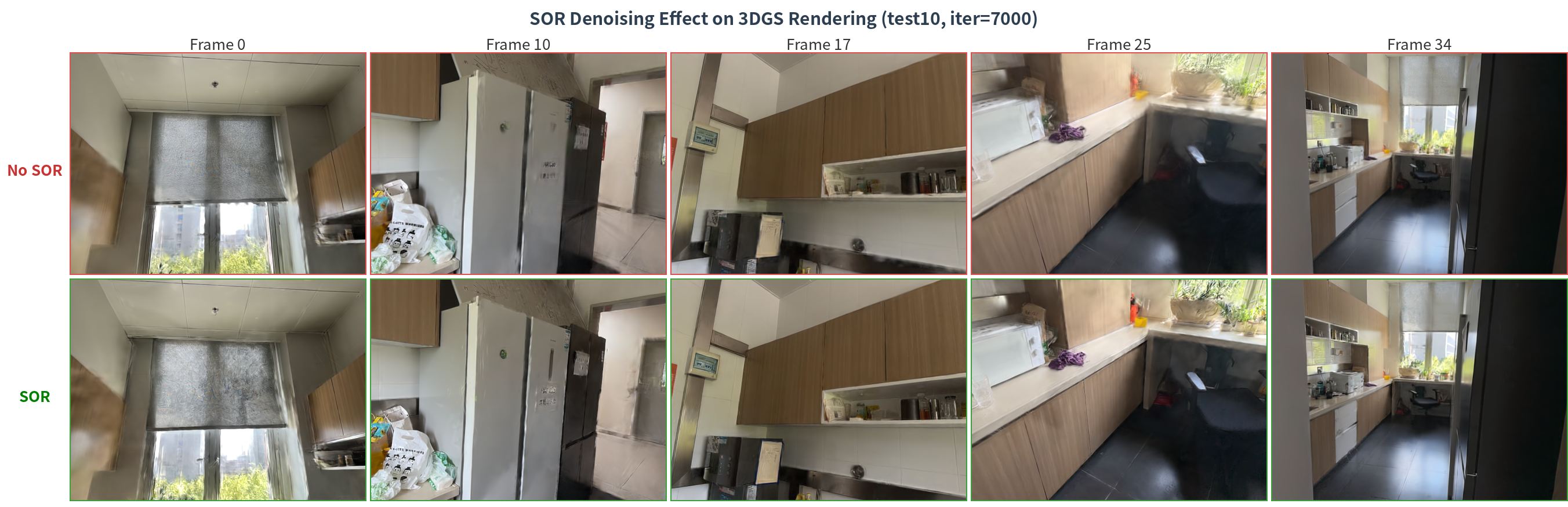
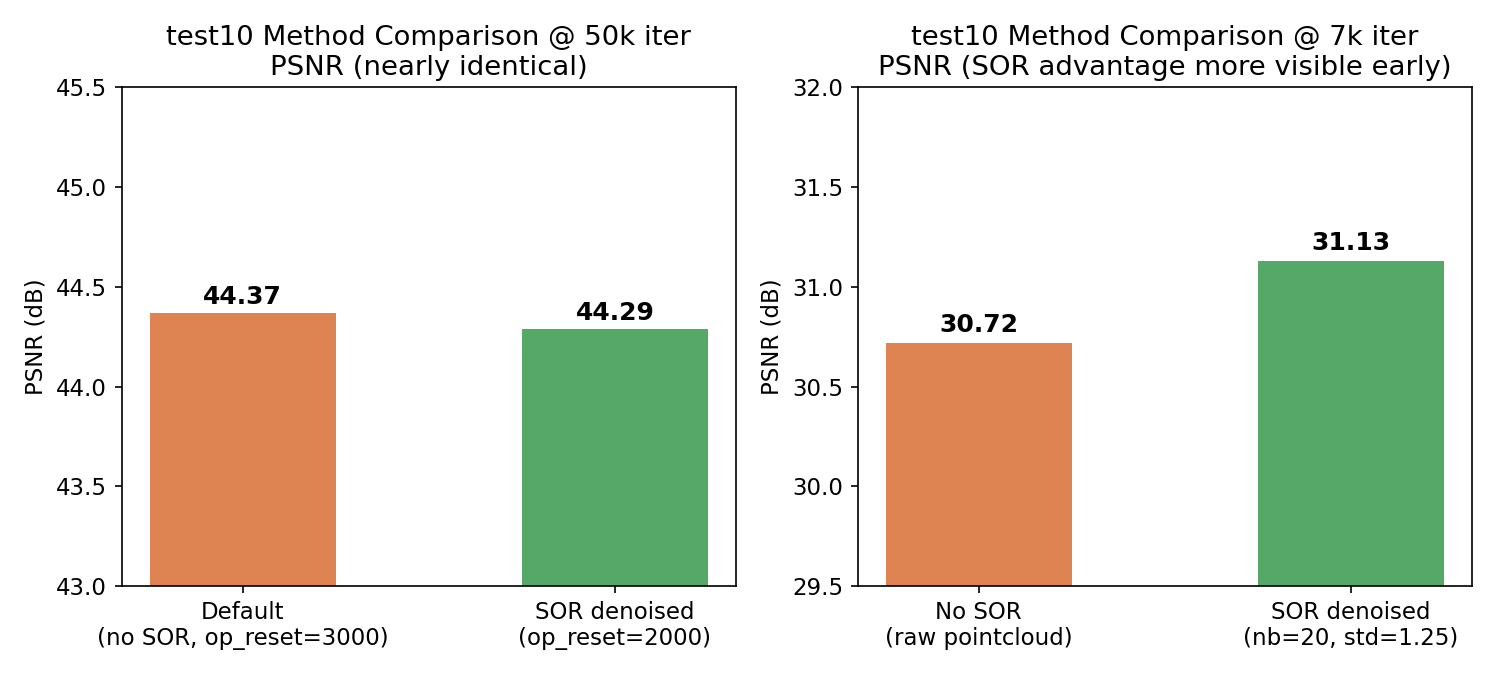
To bridge noisy SLAM outputs and high-fidelity rendering, we integrate Statistical Outlier Removal as a crucial refinement step. By pruning 7.3% of raw data, reducing approximately 1,000k points to 927k points, we eliminate floaters and improve visual stability. The PSNR difference is small, but the qualitative enhancement is substantial.
The PSNR Trap — Overfitting vs. Generalization
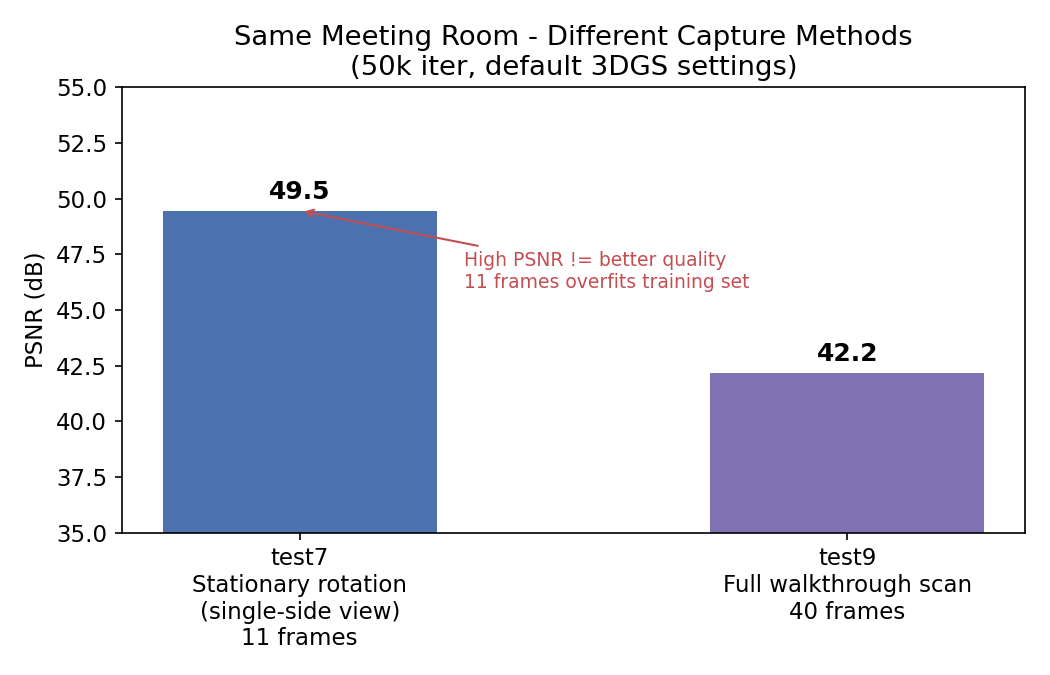
We compare two capture strategies in the same meeting room. A stationary rotation with 11 frames achieves high PSNR but overfits by memorizing training views. A full walkthrough with 40 frames yields lower PSNR but reconstructs a more complete and navigable digital twin.
Real-time Execution & Hardware Constraints
The main experiments use an NVIDIA RTX 4090 with 24GB VRAM. Real-time execution remains constrained by dense transformer matching, high-resolution point cloud processing, and 3DGS optimization. These constraints motivate lighter SLAM backbones, more efficient point cloud refinement, and faster training pipelines.
Acknowledgements
This project was developed as a final project for the Computer Vision course at Southern University of Science and Technology. We sincerely thank Prof. Feng Zheng and Prof. Weiyu Wang for their guidance, suggestions, and support throughout this work.